
Thông tin chi tiết về học tậpCác phương pháp hay nhất về Học tập và Phát triển (L&D)
ISG Buyers Guide™ Learning Content Platforms Report

Trong bài viết này
ISG Buyers Guide™ Learning Content Platforms for Businesses
Learning Content Platforms (LCPs) have moved beyond the era of “more content equals more value.” Enterprises have realized that abundant libraries do not guarantee impact; learners still struggle to find relevant material, and leaders still question ROI. The market response has been clear: Platforms not only aggregate content but also deliver, personalize and measure it.
These solutions promise faster time to relevance, fewer integration headaches and actionable insights for L&D teams under pressure to do more with less. By 2028, Matthew Brown, Director of HCM Research at ISG, states that self-directed career pathing will be utilized by one-half of enterprises using digital learning platforms to dynamically identify skill gaps and learning plans to ensure worker retention and trust.
“Udemy’s positioning as the Category Leader for Learning Content Platforms is driven by its strategic delivery platform—not just its content library. Their deep focus on analytics, labs, and AI successfully elevates the learning experience, providing L&D with crucial visibility into skill inventory, progression, and the true, measurable impact of talent growth beyond simple consumption metrics. It is a highly flexible solution built for maximum impact.” – Matthew Brown, Director of HCM Research at ISG
TL;DR: Key Highlights
- Udemy was named an Exemplary Provider — ranked among the top three leaders in Product and Customer Experience.
- ISG Buyers Guide™ highlights Udemy’s strength in combining content access, delivery, and analytics for measurable impact.
- LCPs are shifting from large catalogs to skills-focused, data-driven learning experiences.
- AI and personalization are driving the next wave of innovation in business learning.
- Download the full ISG Buyers Guide™ to see how Udemy compares across all categories.
Download the full ISG Buyers Guide™ to see how Udemy compares across all categories.
How ISG Buyers Guide™ defines corporate learning content platforms
There is growing expectation that content platforms must enable measurable, skills-aware learning journeys rather than simply provide access. ISG Buyers Guide™ defines Learning Content Platforms as applications that provide access to licensed or curated learning content combined with native platform capabilities for delivery, personalization and analytics.
These platforms allow enterprises to license content from external providers while delivering and tracking it through embedded learner-facing features and reporting tools. Delivery typically occurs through the provider’s own interface, though most platforms also support integration with learning management systems (LMS) or learning experience platform (LXP) environments. This category excludes vendors that only offer static or unstructured catalogs and excludes LXPs where the primary value lies in experience orchestration rather than embedded content delivery and data. In short, LCPs exist to make content usable and measurable, not merely available.
The current state of online learning platforms for business
The market has bifurcated into two clear lanes: content-only services designed to plug into an
LMS and platforms that pair content access with proprietary learner experience and analytics. The latter is where innovation is concentrated. Providers are investing in artificial intelligence (AI)-assisted tagging to enrich metadata, search engines that respect roles and skills and dashboards that reveal which providers, formats and topics deliver the most value.
Increasingly, these platforms adopt an open stance—supporting standards and APIs—so buyers can consume content natively or route it into existing systems without friction. This evolution reflects a broader enterprise priority: reducing vendor sprawl while improving visibility into what works.
Historically, content strategy revolved around catalog size. Organizations licensed multiple libraries, often from different providers, and relied on LMS integrations to make content available. The result was predictable: uneven adoption, redundant assets and limited insight into effectiveness.
The rise of LCPs marked a turning point. By combining content access with delivery and analytics, these platforms gave L&D teams a way to curate intelligently, personalize at scale and demonstrate impact without deploying a full LXP. Today, the conversation has shifted from “how much content do we have?” to “which content moves the needle on skills and business outcomes?”
What enterprises expect from the best corporate learning platforms
Enterprises now expect more than access—they expect alignment. Leaders want proof that
content investments support onboarding velocity, readiness for new tools and coverage of high-demand skills. L&D teams need platforms that reduce manual tagging, simplify curation and provide analytics that answer real questions: Which assets correlate with improved performance? Which formats drive engagement? Which providers justify renewal? For learners, the expectation is equally clear: relevant, personalized recommendations delivered in an intuitive interface, with the option to explore beyond assigned paths when curiosity strikes.
Robust content ecosystems
To meet these needs, successful LCPs must combine robust content ecosystems with intelligent delivery and measurement. That begins with metadata discipline and AI-assisted tagging to ensure content is discoverable by skill, role and level. Personalization should be transparent and explainable, guiding learners toward relevant resources without creating black-box experiences.
Interoperability
Analytics must evolve from usage counts to actionable insights, enabling enterprises to retire underperforming assets and double down on what works. Interoperability is non-negotiable: Platforms must support SCORM, xAPI, and LTI standards, integrate cleanly with LMS and HCM systems and expose APIs for embedding content in portals and productivity tools.
Simplified governance and operational excellence
Skills frameworks and competency models should inform recommendations and reporting, ensuring alignment with job architectures and simplifying governance across regions. Finally, operational excellence matters—licensing visibility, renewal alerts and administrative ergonomics that reduce spreadsheet gymnastics are as critical as the learner experience itself.
Learning content platforms vs. content marketplaces
The distinction between Learning Content Platforms and content marketplaces is important. Marketplaces focus on access and compatibility, offering catalogs intended to plug into an LMS or LXP without providing a native learner experience or robust analytics. LCPs, by contrast, pair the library with delivery, personalization and measurement. Many enterprises will use both, but they solve different problems: marketplaces expand choice, while LCPs make content actionable.
Looking ahead, expect pragmatic innovation. Credentialing and badging will gain traction where proof of progress matters. Video analytics will deepen insight into actual consumption behavior. Skills intelligence layers will become more precise, driving personalized delivery and Leaders want proof that content investments support onboarding velocity, readiness for new tools and coverage of high-informing workforce planning. Lightweight AI “copilots” will assist with discovery and summarization, provided they operate with transparency and avoid adding complexity. Meanwhile, the ability to incorporate creator-led catalogs and niche providers will remain a differentiator for enterprises with regional or specialized needs.
Udemy and overall scoring of software providers across categories
The research finds Udemy is a leading provider. Providers that place in the top three of a category earn the designation of Leader. Cornerstone and Udemy have done so in seven categories, Skillsoft in four, ELB Learning in two and LinkedIn in one category.
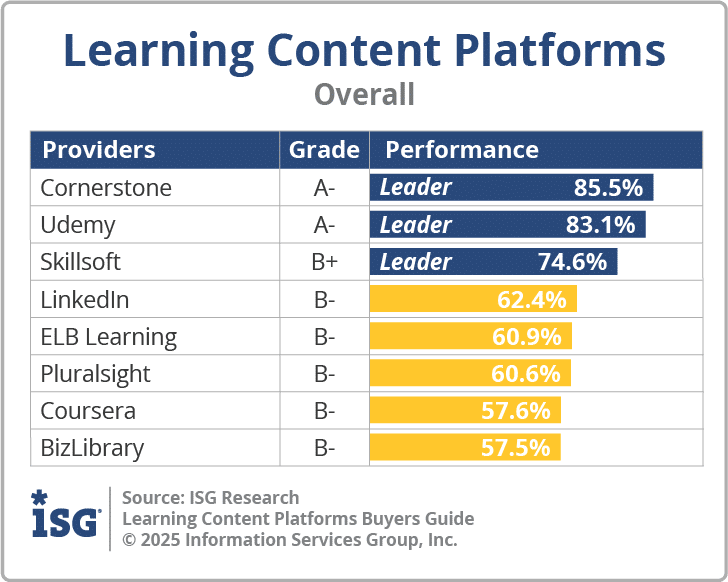
The overall representation of the research below places the rating of the Product Experience and Customer Experience on the x and y axes, respectively, to provide a visual representation and classification of the software providers. Those providers whose Product Experience have a higher weighted performance to the axis in aggregate of the five product categories place farther to the right, while the performance and weighting for the two Customer Experience categories determines placement on the vertical axis. In short, software providers that place closer to the upper-right on this chart performed better than those closer to the lower-left.
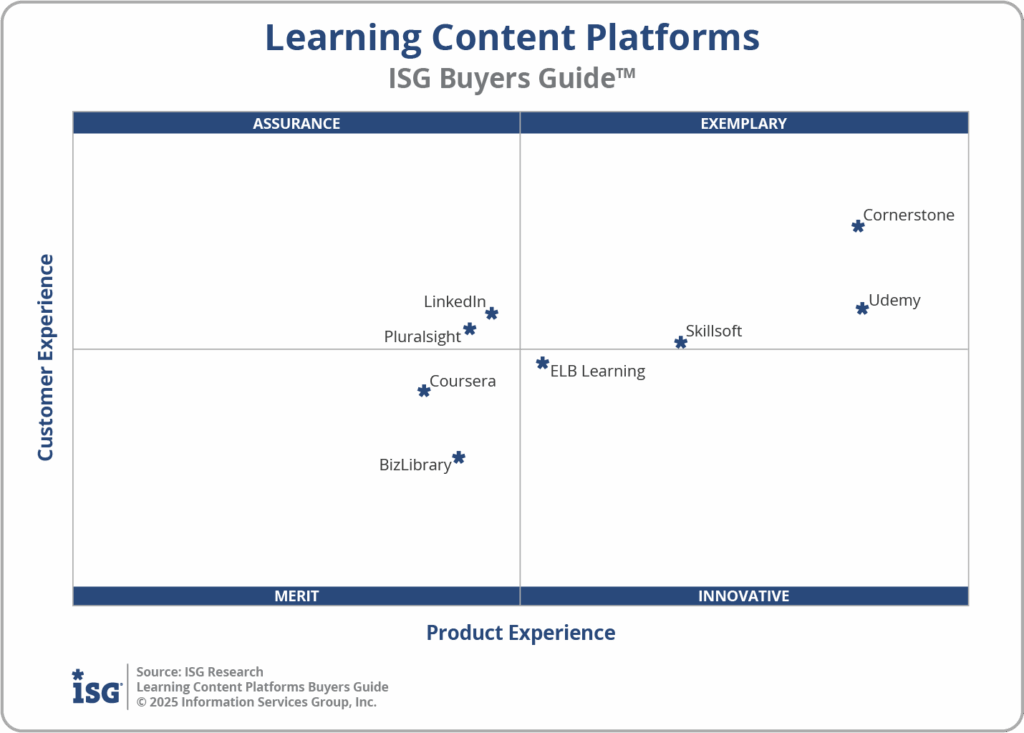
The research places software providers into one of four overall categories: Assurance, Exemplary, Merit or Innovative. This representation classifies providers’ overall weighted performance.
- Exemplary: The categorization and placement of software providers in Exemplary (upper right) represent those that performed the best in meeting the overall Product and Customer Experience requirements. The providers rated Exemplary are: Cornerstone, Skillsoft and Udemy.
- Innovative: The categorization and placement of software providers in Innovative (lower right) represent those that performed the best in meeting the overall Product Experience requirements but did not achieve the highest levels of requirements in Customer Experience. The provider rated Innovative is: ELB Learning.
- The categorization and placement of software providers in Assurance (upper left) represent those that achieved the highest levels in the overall Customer Experience requirements but did not achieve the highest levels of Product Experience. The providers rated Assurance are: LinkedIn and Pluralsight.
- Merit: The categorization of software providers in Merit (lower left) represents those that did not surpass the thresholds for the Assurance, Exemplary or Innovative categories in Customer or Product Experience. The providers rated Merit are: BizLibrary and Coursera.
ISG Buyers Guide™ warns that close provider placement proximity should not be taken to imply that the packages evaluated are functionally identical or equally well suited for use by every enterprise or for a specific process. Although there is a high degree of commonality in how enterprises handle learning content platforms, there are many idiosyncrasies and differences in how they do these functions that can make one software provider’s offering a better fit than another’s for a particular enterprise’s needs.
ISG Buyers Guide™ advises enterprises to assess and evaluate software providers based on organizational requirements and use this research as a supplement to internal evaluation of a provider and products.
Why learning content platforms make most sense for organizations
For buyers, the fit profile is clear. LCPs make sense for organizations seeking measurable engagement on licensed content, not just access; enterprises executing a skills strategy without deploying a full LXP; and mid-market firms that want a centralized home for content plus platform functions. Success stories share a common pattern: curated sets mapped to roles, self-directed exploration for those who desire it and analytics that inform continuous improvement. When tagging, search, recommendations and reporting work as intended, L&D can shift from manual curation to program design and stakeholder engagement—consistent with the “do more with less” reality that has made third-party content a durable extension of the team.
Enterprises evaluating LCP providers should prioritize platforms that deliver more than catalogs. Look for solutions that combine content access with delivery, personalization and analytics; support standards and integrations for interoperability; align recommendations with skills frameworks; and provide admin tools that simplify governance and licensing. In short, choose a platform that makes content not just available, but actionable—so learning investments translate into measurable capability and business impact.
The ISG Buyers Guide™ for Learning Content Platforms evaluates software providers and products in key areas like providing access to licensed or curated learning content combined with native platform capabilities.
These platforms enable organizations to not only license content from external providers but also deliver, track, personalize and optimize it through embedded learner-facing features and analytics.
This research evaluates the following software providers offering products that address key elements of learning content platforms as ISG Buyers Guide™ defines it: BizLibrary, Cornerstone, Coursera, ELB Learning, LinkedIn, Pluralsight, Skillsoft and Udemy.
Discover Udemy’s full score compared to competitors
For over two decades, ISG Buyers Guide™ Research has conducted market research in a spectrum of areas across business applications, tools and technologies. We have designed the Buyers Guide to provide a balanced perspective of software providers and products that is rooted in an understanding of the business requirements in any enterprise.
The ISG Buyers Guide™ for Learning Content Platforms is the distillation of over a year of market and product research efforts. It is an assessment of how well software providers’ offerings address enterprises’ requirements for learning content platforms.
Download the full report to learn how Udemy compares across all categories against competitors.
Disclaimer: The ISG Buyers Guide™ for Learning Content Platforms is only available in English.
Download the report
Bằng việc đăng ký, bạn đồng ý với Điều khoản sử dụng và Chính sách về quyền riêng tư của chúng tôi.