
Transforming enterprise learning with Model Context Protocol (MCP)


Organizations often face challenges with disconnected tools, isolated knowledge systems, and learning platforms that don’t integrate well with daily workflows. The Model Context Protocol (MCP), developed by Anthropic, is an open-source protocol that addresses these integration issues. MCP functions as a standardized interface that allows AI tools, data systems, and learning platforms to communicate more effectively.
This blog explores how MCP works and its potential applications in enterprise learning. MCP allows AI assistants to talk directly with the AI Assistant in learning systems. This helps to deliver relevant training content within existing workflows, connecting previously isolated AI tools, and supporting contextual skills development based on immediate work needs. Picture a new team leader preparing for their first executive presentation. As they work, their AI Assistant suggests a course on ‘Executive Communication Strategies.’ No searching, no context switching, just relevant skill-building integrated into their prep work. This exemplifies how MCP offers a different approach to employee development that aligns with actual work processes.
Through this protocol, learning happens in the moment of need, within the tools people already use, without disrupting the work that needs to get done. Organizations can explore new ways to connect employee development with operational requirements, potentially improving both learning outcomes and workflow efficiency.
Bridging the gap in modern enterprise tools
The way we work, learn, and harness technology is rapidly transforming. Teams are unlocking productivity gains with the help of AI. Yet, for all their potential, these tools often fail to work together effectively.
One of the biggest challenges organizations face today is that their systems don’t speak the same language. AI assistants operate in silos, learning platforms remain isolated, and critical data is often locked away in separate databases. Employees waste valuable time toggling between tools, manually searching for information, and trying to solve problems in disconnected workflows.
This is more than just an inconvenience. It’s a barrier to innovation, productivity, and employee growth. The question is clear. How can businesses reimagine these systems to work better together while empowering their workforce to grow?
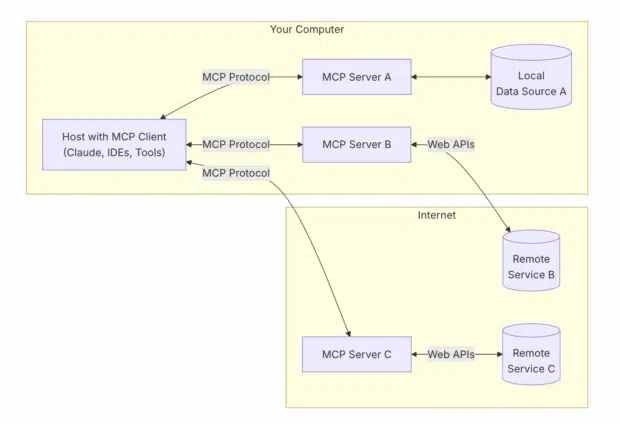
The transformative features of MCP
Here’s why MCP is a game-changer:
- Integration without friction: MCP ensures different AI tools and systems work together seamlessly, overcoming interoperability barriers and making workflows more efficient.
- Real-time context: By bridging internal enterprise data and external platforms, MCP delivers actionable insights and real-time information when it matters most.
- Unified workflows: MCP integrates disparate tools into cohesive systems, reducing inefficiencies and enhancing productivity.
For organizations exploring the capabilities of MCP, this MCP Crash Course on Udemy provides a practical introduction to designing and building with the protocol.
How MCP impacts upskilling and reskilling
While MCP is transformative across a wide range of applications, it holds particular potential in addressing the inefficiencies in traditional learning models. In most workplaces, upskilling requires employees to leave their workflows, navigate disconnected systems, and access generic training resources that often fail to meet their specific needs. MCP changes this by embedding learning into the flow of work, making upskilling seamless, personalized, and highly effective.
Enabling learning in the flow of work
Using MCP, businesses can integrate skill-building directly into employees’ existing tools and workflows. Instead of interrupting tasks to search for courses, employees can access role-specific recommendations and actionable learning resources without leaving their workflow.
For example:
- Scenario: A team leader preparing for their first major product launch asks their AI assistant how to improve their planning skills.
- MCP Solution: Within seconds, the assistant retrieves recommendations from Udemy Business, such as courses on product management or team collaboration, aligned to the leader’s role and current goals.
Breaking down silos in knowledge systems
By connecting AI tools, organizational databases, and external platforms, MCP unifies previously siloed systems. This not only improves the efficiency of learning systems but ensures training aligns with both employee needs and organizational objectives.
MCP brings the right learning opportunity to the right person at the right time, whether it’s mastering analytics, improving leadership, or preparing for a role transition.
Why is MCP the future of workforce learning?
As the AI-powered platform to reskill and upskill the future workforce, Udemy is reimagining what’s possible with the Model Context Protocol (MCP). Through its Innovation Studio, Udemy is designing the next evolution of skill-building by developing an MCP server to integrate Udemy Business courses into enterprise AI tools seamlessly. This approach isn’t just about making training more accessible. It’s about redefining how employees engage with learning in real-time, on their terms, and directly within their workflows.
By adopting MCP early, Udemy reinforces its commitment to shaping the future of enterprise learning, where our goal is for personalized, just-in-time training to become the standard for workforce development. Once launched, the Udemy MCP server will transform how organizations empower employees by embedding learning into the tools they already use, aligning skills development with dynamic business needs.
The vision of our Udemy MCP server
Here’s how we envision the Udemy MCP server will revolutionize enterprise learning workflows:
- Contextual search: Employees will find relevant Udemy Business courses directly within their existing AI tools and workflows, eliminating platform switching.
- Intelligent recommendations: AI-powered suggestions will automatically surface the most applicable courses based on current work tasks and skill requirements.
Instant access: Seamless integration enables immediate course enrollment and learning without leaving the employee’s primary work environment.
What’s next for the Udemy MCP server?
Udemy’s plan for an MCP server goes far beyond initial integrations. The platform is built for continuous innovation, with exciting future capabilities on the horizon:
- Expanding capabilities: Upcoming plans to introduce tools for creating custom learning objects, advanced performance analytics, and deeper insights into employee skill development.
Early Adopters Program: Through this initiative, Udemy invites leading organizations to co-create the future of MCP, testing new features, providing feedback, and pioneering the use of embedded learning tools in the workplace.
By bringing together industry-leading expertise, cutting-edge AI technology, and the innovative spirit of its Innovation Studio, Udemy is setting the stage for MCP’s transformative impact on enterprise learning. The future of skill-building hasn’t just arrived. It’s being built, and Udemy is helping to build it. Read more here.